
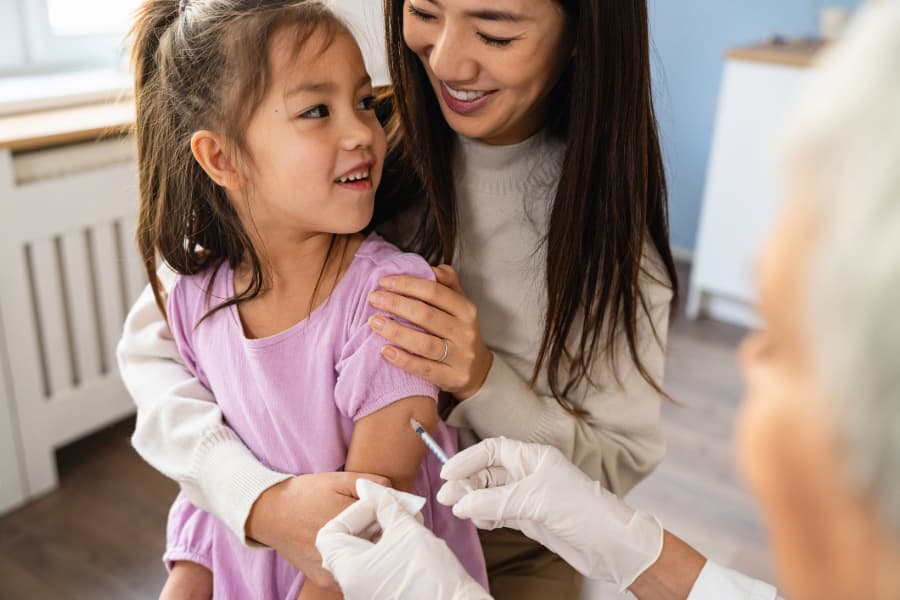
New parents have a lot of information to absorb. With parenthood guides, vaccination schedules, and more, it is natural to feel overwhelmed. Fortunately, you don’t have to navigate your child’s medical needs alone. Touchpoint Pediatrics provides personalized care from board-certified pediatricians. Here, we discuss the recommended childhood vaccination schedule and what to do if your child falls behind.
Key Takeaways
- Childhood vaccinations take advantage of a child’s developing immune system to provide lifelong protection against serious diseases.
- Staying up to date with your child’s immunization schedule is the best way to protect them against illness in both the short and long term.
- If your child is behind on their vaccinations, contact your Touchpoint pediatrician to discuss an appropriate catch-up schedule.
Birth to Six Months: The Early Series
The vaccines received between birth and six months old are often called the “early series.” These immunizations are focused on preventing severe childhood illnesses, many of which can cause lifelong complications if contracted as a baby. New moms should schedule their first vaccination appointment at two months old for the following shots:
- Hepatitis B
- Rotavirus
- DTaP (diphtheria, tetanus, and whooping cough)
- Hib (Haemophilus influenzae type B)
- PCV (pneumococcal disease)
- IPV (polio)
Babies born within the respiratory syncytial virus (RSV) season from October to March are given the RSV vaccine within one week of birth. If the baby is not born during RSV season, they will get the RSV shot when they are under eight months old, shortly before RSV season begins. Some children at high risk may receive it before their second season. If the mother received the RSV vaccine at least 14 days before delivery, the baby generally does not need the antibody shot.
At four months old, your baby repeats all of the above vaccinations. The repeat shots, called boosters, help to reinforce the immunity provided by the first set. Babies receive a third booster at six months old, in addition to the following:
- COVID-19
- Influenza (flu)
These shots protect your baby during their most sensitive period, providing both short-term and long-term defense to ensure a strong start to life.
12 to 18 Months: Boosters and New Milestones
After reaching one year old, your baby will receive their final boosters for most infant vaccinations. As before, these help to extend and reinforce their immunity. At the same time, new vaccinations are added to the schedule. These protect against diseases that are rare for infants, but common for toddlers and young children. They include:
- MMR (measles, mumps, and rubella)
- Varicella (chickenpox)
- Hepatitis A
12-18 months also marks the beginning of annual boosters. Influenza (flu) and COVID-19 shots should be repeated annually to provide the best coverage. That is because both viruses can mutate rapidly, meaning that previous immunizations may become obsolete. By repeating the shots every year, children can be protected against the latest evolution of each disease.
Ages Four to Six: Kindergarten Prep
Between ages two and three, kids don’t need any shots except their annual flu and COVID-19 shots. The next round of new vaccinations does not begin until age four. These vaccinations aim to prepare your child for school. At school, your child will come into contact with many other kids, increasing the likelihood that they are exposed to disease. Kindergarten prep shots include the following:
- Varicella (chickenpox)
- DTaP (diphtheria, tetanus, and whooping cough)
- MMR (measles, mumps, and rubella)
- IPV (polio)
- Influenza
These shots protect against common childhood illnesses. Immunization keeps your child healthy, letting them focus on learning and making friends.
Keeping Track
If this sounds like a lot to keep track of, don’t worry. You don’t have to track your child’s vaccinations by yourself. The Touchpoint Pediatrics patient portal provides easy access to information about your child’s immunizations, including reminders for when they are due for shots. School forms will also tell you which shots are required before enrolling.
It’s important for kids to receive all their shots on schedule. If you fall behind, however, American Academy of Pediatrics provides a childhood vaccination catch-up schedule. Get in touch with your Touchpoint pediatrician to devise the best schedule to get your child back on track. Some boosters need to be administered at specific intervals to be most effective, so your child may need more shots than they would receive otherwise.
Get Started with Childhood Vaccinations Near You in NJ
Staying up to date with the recommended immunization schedule is the best way to protect your child against disease. Learn more about childhood vaccinations at Touchpoint Pediatrics. We provide personalized, patient-centered care in Chatham, New Jersey, serving families in Morristown, Summit, Berkeley Heights, Hoboken, and beyond. Contact us to schedule your “Meet You” appointment.
Childhood Vaccination Schedule FAQs
Can my child get vaccines if they are sick?
Yes, your child can get vaccines while they have a mild sickness. You can discuss this with your Touchpoint pediatrician at the time of the visit.
How do combination vaccines work?
Combination vaccines protect against multiple diseases with a single shot. This makes them easier and less stressful for young children. Touchpoint prides itself on offering the most preservative-free and heavy metal-free vaccines. This is why we don’t offer the combination vaccines if the single components are available. Our alternative vaccine schedule allows our patients to spread out the administration of vaccines at no additional cost.
Do vaccine schedules differ by state or school district?
Yes, vaccine schedules and requirements differ based on specific state mandates.
How do I get an updated immunization record for daycare or school?
You can request an updated record through our Patient Portal.